


Family Trust Tax Changes: Where Things Stand (November 2026)

If you have a family trust, 2026 has been a big year. The Federal Budget proposed the largest change to how discretionary trusts are taxed in decades, the High Court handed down a long-awaited decision on trust distributions to companies, and the legislation is now in its final stage in Parliament. Here's where things stand as at 23 November 2026.
1. The proposed 30% minimum tax on discretionary trusts
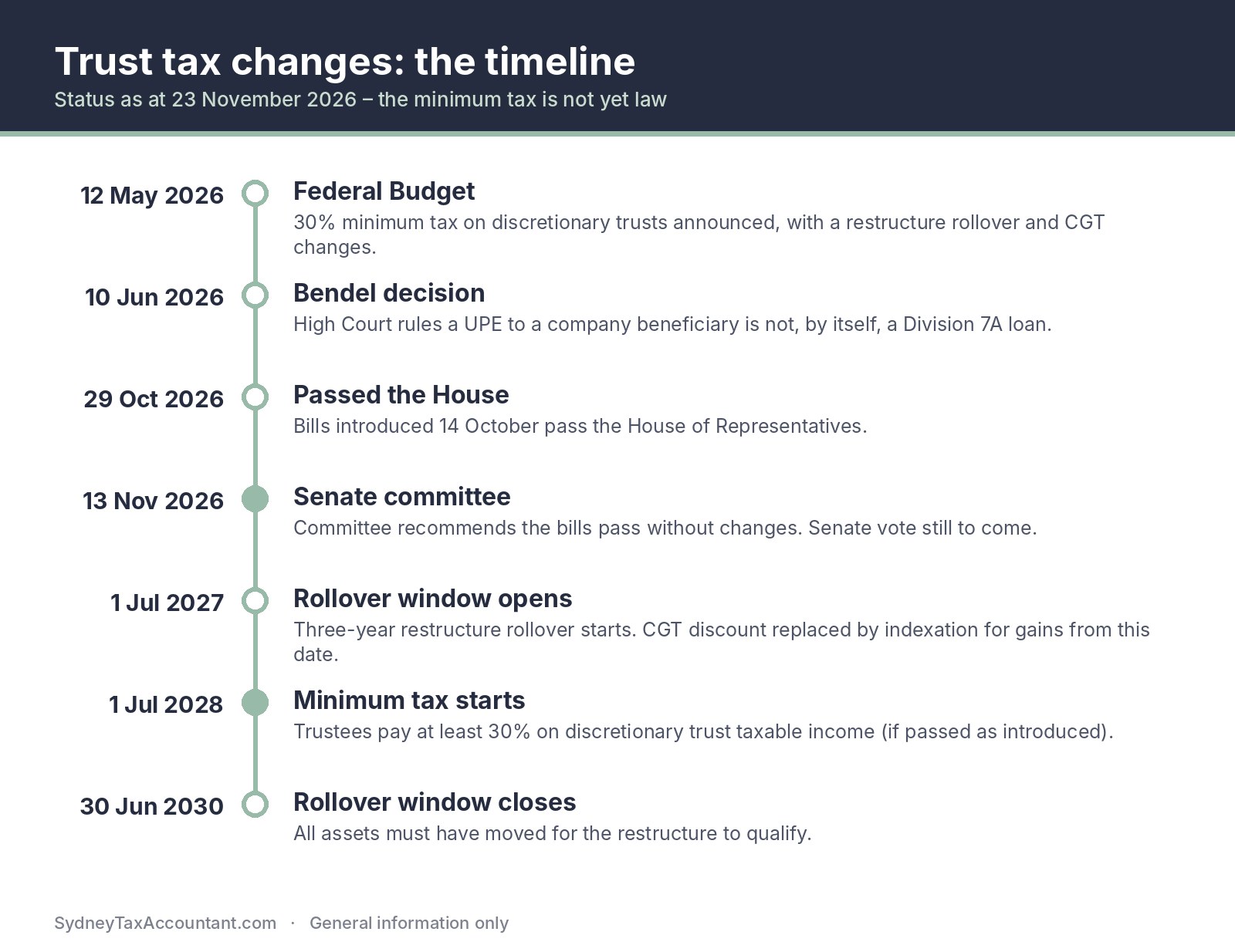
Status: not yet law. The bills (the Treasury Laws Amendment (Tax Reform No. 3) Bill 2026 and the Income Tax Rates Amendment (Minimum Tax on Discretionary Trusts) Bill 2026) passed the House of Representatives on 29 October. On 13 November, a Senate committee recommended they pass without changes. The Senate still has to vote, and the Government is aiming to do that before Parliament rises for the year.
If passed as introduced, from 1 July 2028:
- The trustee pays a minimum 30% tax on the trust's taxable income, whether it comes from a trading business or investments.
- Individual beneficiaries get a non-refundable credit for the tax paid by the trustee. If your marginal rate is above 30%, you pay the difference. If it's below 30%, you can't get the difference back.
- Company beneficiaries ("bucket companies") get no credit. Income distributed to a company would be taxed at 30% in the trust and then taxed again in the company.
- Franking credits would be used against the trustee's tax rather than passed through to beneficiaries.
Who's not affected: fixed unit trusts, super funds and SMSFs, special disability trusts, deceased estates and charitable trusts. Some income is also carved out, including primary production income, certain income of vulnerable minors, and income of genuine testamentary trusts (with integrity rules for assets added after Budget night, 12 May 2026).
Who's most affected: families who currently distribute to beneficiaries on low tax rates, such as a non-working spouse, adult children at university or retired parents, and businesses that rely on a bucket company to cap tax at the company rate.
2. Two ways out: restructure or elect
The bills include two alternatives to paying the minimum tax, and you can only choose one:
- Restructure rollover (1 July 2027 to 30 June 2030). Move the trust's assets into a company, a fixed trust, an individual or a partnership without triggering income tax or CGT. The new entity inherits the trust's cost base, can't have discretionary features for four years, and all assets must move within the window. The rollover doesn't cover stamp duty or GST, which can make restructuring expensive, particularly for property.
- Excluded election trust. A trust that exists on 1 July 2028 can make a once-only election in 2028–29 to stay outside the minimum tax, but must lock in its beneficiaries and their fixed shares of income and capital permanently. Departing from the nomination brings heavy penalties.
3. Already decided: Bendel and bucket companies
On 10 June 2026, the High Court ruled 5–2 in Commissioner of Taxation v Bendel that an unpaid present entitlement (UPE) owed by a trust to a company beneficiary is not a loan under Division 7A just because it hasn't been paid. This overturned an ATO view that had been in place since 2009, and the ATO has said it will follow the decision.
That's good news for trusts with old UPEs, but it isn't a free pass. Other rules, including Subdivision EA of Division 7A and section 100A, can still apply depending on what happens to the money. If you have UPEs on your trust's balance sheet, it's worth reviewing how they're documented.
4. Also changing: capital gains
Separately, from 1 July 2027 the 50% CGT discount for individuals and trusts is to be replaced by cost base indexation, with a 30% minimum tax on net capital gains. That affects when it makes sense to sell assets, and any decision to restructure.
What should you do now?
- Don't rush to restructure. The law isn't final, the rollover window doesn't open until July 2027, and stamp duty may make restructuring too expensive.
- Model your options. For each trust, compare the three paths: restructure, elect out, or stay put and pay the minimum tax. Your current distribution pattern will drive the answer.
- Review bucket company arrangements and UPEs in light of Bendel and the proposed loss of credits for company beneficiaries.
- Check your trust deed and your will, especially clauses about distributions to companies and testamentary trusts.
- Keep 2026–27 distributions on track. The minimum tax doesn't apply until 2028–29, so the normal rules apply for this year's 30 June resolutions.
Frequently asked questions
Is the 30% minimum tax on discretionary trusts law yet?
No. As at 23 November 2026 the bills have passed the House of Representatives and a Senate committee has recommended they pass, but the Senate has not voted. If passed as introduced, the tax starts on 1 July 2028.
Does the minimum tax apply to my bucket company?
Under the bills as introduced, income distributed to a company beneficiary would be taxed at 30% in the trust and the company would get no credit for that tax.
Should I restructure my family trust now?
Not yet. The law isn't final, the restructure rollover only opens on 1 July 2027, and stamp duty is not covered. Model your options first.
What did the High Court decide in Bendel?
On 10 June 2026 the High Court held 5–2 that an unpaid present entitlement owed by a trust to a company beneficiary is not, by itself, a loan for Division 7A purposes.
How we can help
SydneyTaxAccountant.com prepares trust returns and distribution resolutions for family businesses and investors across Sydney. Australian returns are lodged through our tax agent partner, OM Tax Services (Tax Agent No. 26072249). We'll update this article once the Senate votes.
Need help? Call 1300 661 380 or book a free consultation to review your trust structure.
This article is general information only and doesn't take your personal circumstances into account. The proposed measures may change before they become law.
Our Recent Blogs




Agent #49872
AUSTRAC Reporting Entity (AAN 209508272)


