

US Year-End Checklist for Americans in Australia (2026)

The US tax year ends on 31 December, six months into Australia's financial year. If you're a US citizen or green card holder living in Australia, a little planning before Christmas makes your US return easier and can reduce what you owe. Here's a checklist.
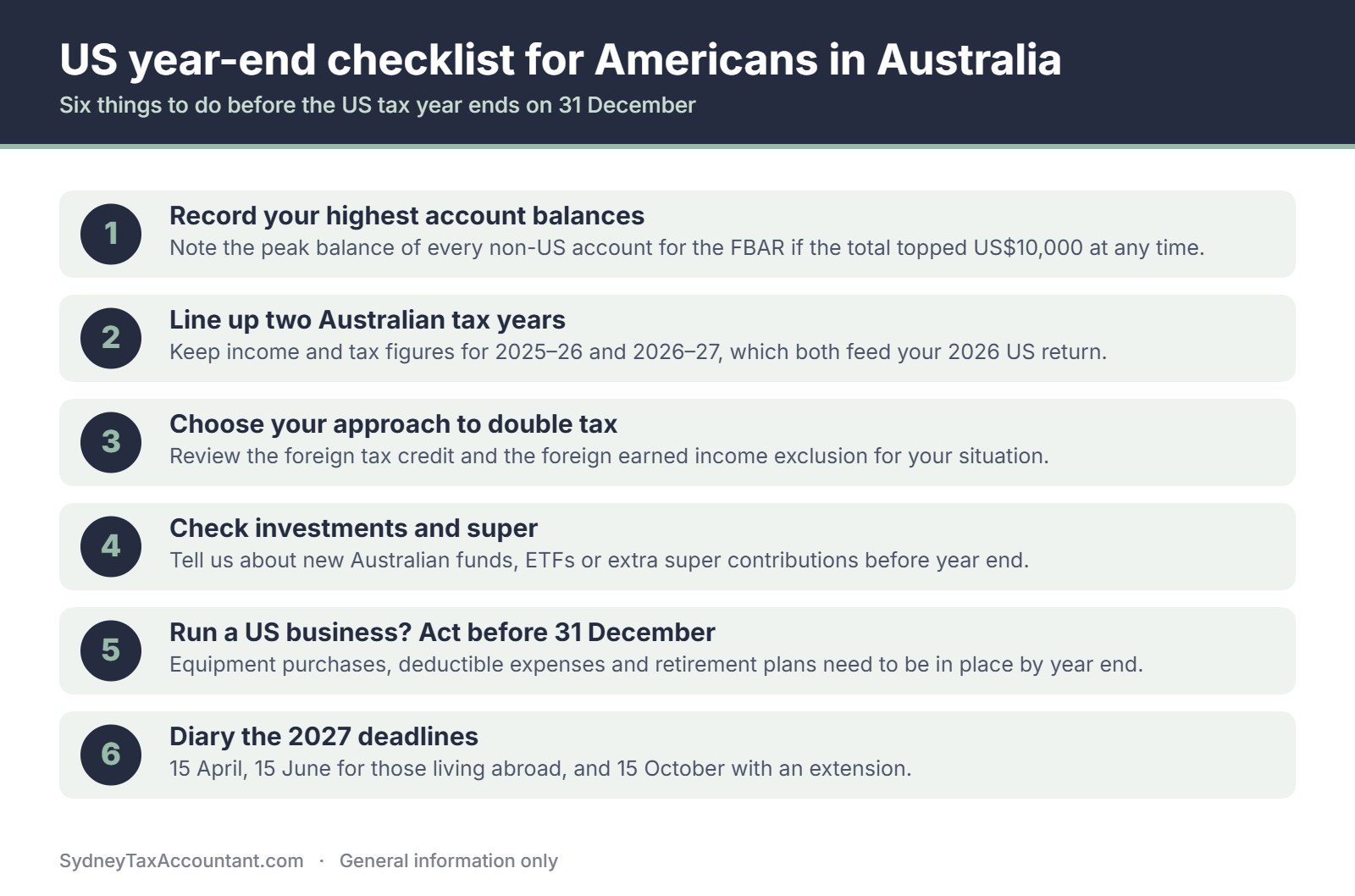
1. Record your highest account balances
If your non-US accounts, including Australian bank accounts, term deposits, shares and accounts you can sign on, totalled more than US$10,000 at any time in 2026, you'll need to file an FBAR. Note the highest balance of each account during the year, and keep the statements. See FBAR and FATCA explained.
2. Line up two Australian tax years
Your 2026 US return covers January to December, which falls across two Australian financial years: 2025–26 and 2026–27. Keep your income statement, bank interest, dividends and any rental or business figures for both, so your income and the Australian tax you've paid can be converted and matched correctly.
3. Choose your approach to double tax
Most Americans in Australia avoid double tax through the foreign tax credit, the foreign earned income exclusion, or a mix of both. The right choice depends on your income, the Australian tax you've paid and your plans, and switching between them has consequences, so it's worth reviewing each year.
4. Check investments and super
Australian managed funds and ETFs can be treated harshly under US rules, and superannuation doesn't fit neatly into either system. If you've bought new investments this year, or made extra super contributions, tell us before year end so we can consider the US treatment.
5. Run a US business or LLC? Act before 31 December
If you own a US business, year-end decisions such as buying equipment (100% bonus depreciation and Section 179), paying deductible expenses and setting up retirement plans need to happen before 31 December. Our partner Waycorp Advisors Inc. covers these in Year-end tax moves for US small businesses in 2026.
6. Diary the 2027 deadlines
- 15 April 2027: normal due date for your 2026 Form 1040 and FBAR, and when interest starts on any tax owing.
- 15 June 2027: automatic two-month extension if you live and work outside the US.
- 15 October 2027: extended due date with Form 4868, and the automatic FBAR extension.
More detail is in US tax deadlines for Americans living in Australia.
Behind on your US filings?
If you haven't filed for a few years and the failure wasn't wilful, the IRS Streamlined Foreign Offshore Procedures let eligible taxpayers catch up by filing three years of returns and six years of FBARs, generally without failure-to-file penalties.
Frequently asked questions
When does the US tax year end for Americans in Australia?
The US tax year is the calendar year, so it ends on 31 December, while the Australian financial year runs from 1 July to 30 June. Your US return draws on income from two Australian financial years.
Do I need to file an FBAR for my Australian bank accounts?
Yes, if the combined balance of your non-US accounts was more than US$10,000 at any time during the year. The FBAR is due 15 April with an automatic extension to 15 October.
When is my US tax return due if I live in Australia?
The normal due date is 15 April, with an automatic extension to 15 June if you live and work outside the US, and a further extension to 15 October if you file Form 4868.
How we can help
SydneyTaxAccountant.com prepares Australian and US returns together for Americans in Sydney and across Australia. US returns are prepared and filed by Waycorp Advisors Inc., an authorised IRS e-file provider, and Australian returns are lodged through our tax agent partner, OM Tax Services (Tax Agent No. 26072249).
Need help? Call 1300 661 380 or book a free consultation.
This article is general information only and doesn't take your personal circumstances into account.
Our Recent Blogs




Agent #49872
AUSTRAC Reporting Entity (AAN 209508272)


